
When a Resident is Struggling: What GME Knows That Programs Don't Always Document

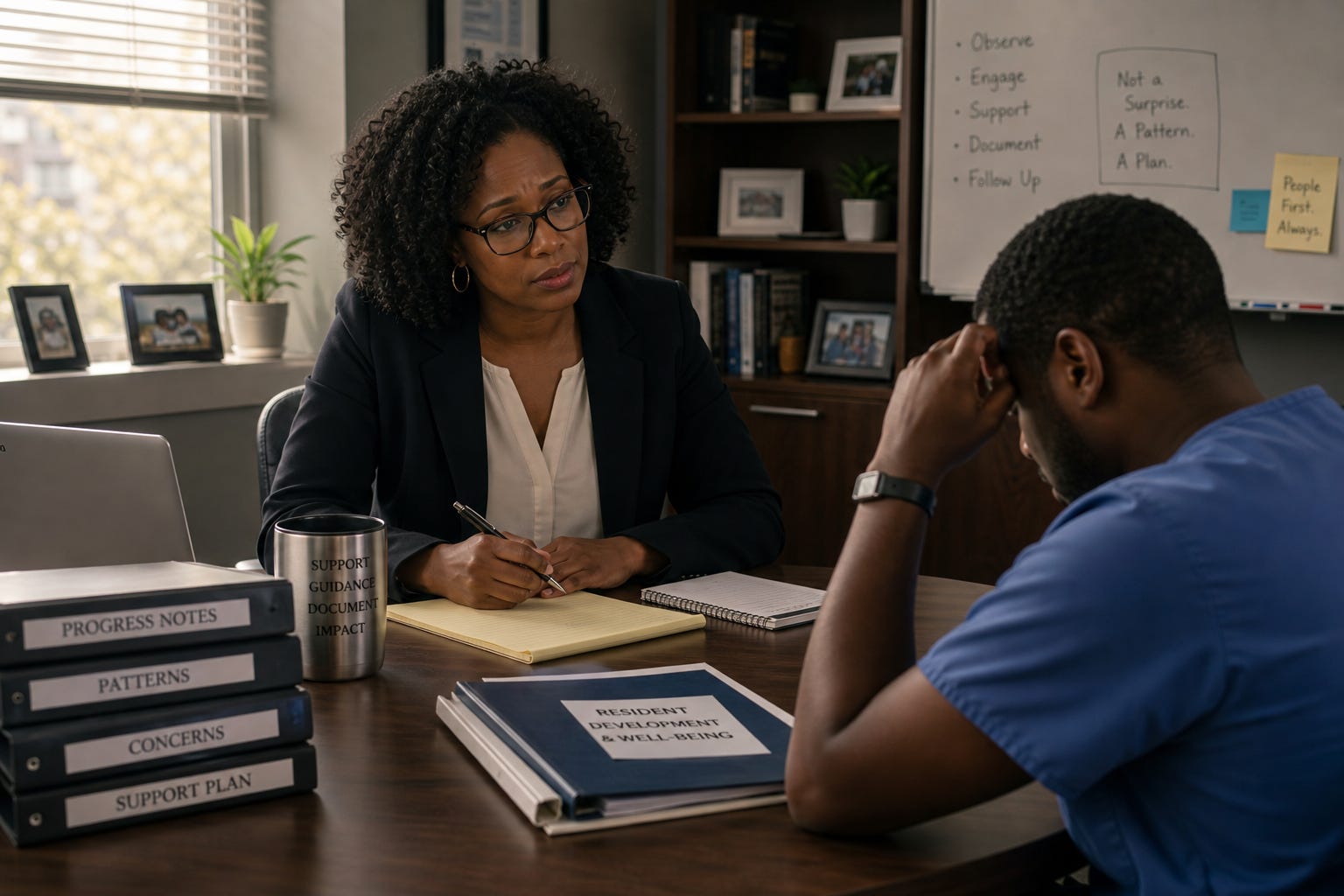
The call come sin and it’s always a version of the same call.
A program coordinator mentions, almost in passing, that the program director and a faculty member have been meeting with a resident. There might be concerns about performance. They might be starting the documentation process. They might not. They aren’t sure what to do next.
Sometimes the call comes from the program director directly. Sometimes GME finds out through a coordinator who heard something in the hallway. Sometimes GME doesn’t find out at all until the situation has escalated to the point where a formal action is already being considered, and the questions becomes: what’s in the file?
The answer, more often than it should be, is not much.
And yet, almost always, people knew. They had known for a while.
Not All Struggling Looks the Same
Before anything else, it is worth naming something that gets lost in the urgency of these situations. Struggling residents are not a single category.
Some residents arrive in July having come through medical school without ever being taught how to write a note efficiently, manage a patient list under pressure, or organize their clinical thinking in real time. They are not failing, they are behind on skills that someone, should have taught them. and they are trying to catch up while simultaneously learning everything else residency requires. These residents often self-correct with the right support. What they need is coaching, early and specific, not a corrective action plan.
Some are struggling because of something happening in their lives outside the hospital. A family crisis. A relationship ending. Financial pressure. Grief. The kind of weight that follows a person into every room they enter. Their clinical performance may be suffering, but the root cause is not clinical. These residents need someone to notice. Genuinely notice before the performance concern becomes the only thing anyone sees.
And some residents have always found this kind of work genuinely difficult. The cognitive demands of clinical reasoning, the organizational complexity of managing multiple patients, the translation of what they observed at the bedside into coherent documentation. These are things they will need more sustained support to develop. They are not lost causes. But they need something more structured and more consistent than a single feedback conversation.
Three very different situations. And in many programs, they are handled the same way or not handled at all, until they can no longer be ignored.
What the Early Signs Look Like
The signs appear before anyone has named them as signs.
A resident who struggles to present patients in a way that tells a clear clinical story. Notes that don’t get closed. Charts that sit open at the end of a shift because the resident cannot synthesize what happened into a coherent narrative. Difficulty prioritizing when the list gets long and everything feels equally urgent. An attending who mentions something informally at the end of a rotation; not quite feedback, not quite a complaint, just a quiet observation that lands somewhere and disappears.
A coordinator who notices that a particular resident always seems to be the last one out. A nurse who mentions to no one in particular that something feels off. A peer who covers for a colleague more than seems normal and a doesn’t know how to say no.
These are not vague impressions. They are data. And they are almost never written down at the moment they appear.
They live in conversations. In the hallway, in the break room, in the informal debrief after a difficult shift. They are known; sometimes widely known and they do not make it into a formal record until the situation has reached a point where formal action feels like the only option left.
Why It Doesn’t Get Documented
The reasons are real and worth naming without judgement.
Faculty are uncomfortable with formal feedback that feels consequential. Writing down a concern about a resident feels different from saying it out loud, more permanent, more serious, more likely to define a person in ways that can’t be taken back. So the concern gets mentioned verbally and left there.
There is persistent hope that the resident will self-correct. Medicine has a long tradition of assuming that difficulty is temporary, that the demands of the environment will eventually produce the competence they require, that time and exposure will do what deliberate intervention might accomplish more efficiently. Sometimes this is true. Often it isn’t and by the time it becomes clear, the window for early support has closed.
There is genuine uncertainty about thresholds. Faculty aren’t always sure whether what they’re observing rises to the level of something that needs to be formally documented. They don’t want to overreact. They don’t want to be the person who flagged something that turned out to be nothing. And in the absence of clear guidance or a trusted process for raising early concerns, the path of least resistance is silence.
And underneath all of it, there is the the cultural reality of medicine: naming a struggling colleague, even a trainee, even with the best intentions, can feel like a betrayal. The instinct toward protection. Toward giving someone the benefit of the doubt, toward not making things harder than they already are is not callousness. It is, in its own way, a form of care. It just isn’t the form that actually helps.
What Happens When Programs Skip Straight to Corrective Action
When concerns that have been building for months finally surface formally, programs often move directly to corrective action plan, probation, or formal documentation without first asking whether other avenues have been tried.
This is where GME can and should be a resource and where the missed opportunity is most significant.
A corrective action plan is a tool. It is not a first step. Before a program moves to formal corrective action, there are questions worth asking: Has the resident received specific, documented feedback about the concern? Has anyone sat with them to understand what is driving the difficulty? Has a coach, a mentor, or a learning specialist been involved? Have GME been consulted? Have outside resources- counseling, academic support, professional coaching been offered and documented?
In many cases, the answer to most of these questions is no.
Programs reach for the formal process because it feels like doing something. And sometimes formal processes are necessary and appropriate. But a corrective action plan issued without prior documented support is not just a missed opportunity for the resident it is a liability for the program. It crates a record that begins with consequences rather than care, and that is a difficult record to defent when it matters.
The residents who are best served and the programs that are best protected are the ones where the documentation trail shows a thoughtful progression: early concern noted, support offered, progress monitored, outcomes reviewed. That trail tells a story of an institution that tried to help before it moved to hold accountable.
That story requires starting earlier than most programs do.
The Role GME Should Be Playing
GME sits in a unique position in these situations.
It sees across programs. It hears the pattern of concern that no single department has the full picture of. It knows which issues are common in the transition from medical school to clinical training. The note writing, the list management, the clinical reasoning under pressure and which one suggest something that needs more individualized attention. It has often seen versions of this situation before and has a sense of what has worked and what hasn’t.
That institutional perspective is a resource. And it is frequently underused.
When programs call GME after a situation has already escalated, the question is almost always backward. What do we do now? The most useful version of that question is the one that almost never gets asked: what should we have done earlier, and what can we do right now that isn’t just escalation?
GME can help programs think through what kind of struggling they are dealing with. It can connect residents and programs with outside resources-mental health support, academic coaching, professional development, before these resources feel like a last resort. It can help establish a documentation trail that reflects genuine support rather than sudden scrutiny. And it can provide the kind of institutional memory that helps programs understand they are not alone is what they are navigating.
None of these requires GME to adjudicate individual cases or override program authority. It requires GME to be genuinely available as a thought partner, a resource navigator, and an institutional memory before the situation has reached the point where options are limited.
What Earlier Identification Actually Requires
Earlier identification of struggling residents is not about surveillance. It is not about labeling people at the first sign of difficulty or creating a culture of heightened scrutiny that makes an already demanding training environment more anxious.
It is about building the conditions where early concerns can be named; specifically, behaviorally, tied to observable performance rather than global impressions in a way that opens a door rather than closes one.
A resident who has documented coaching conversation in month two, with clear observations and a plan for support, is in a fundamentally different position than a resident who has nothing in their file until month eight. So is the program. So is the institution.
The documentation, done well, is not a weapon. It is a map of where the resident started, what support was offered, how they responded, and what the nest step should be. That map serves the resident when things improve. It serves the program when they don’t. And it serves the institution when it needs to demonstrate that its processes were fair, deliberate, and genuinely oriented toward helping someone succed.
Closing Reflection
The residents who struggle in silence- whose difficulty is known but unwritten, discussed but undocumented, observed but unaddressed are not well served by the instinct to protect them from formal processes.
They are well served by institutions that notice early. That name concerns specifically and supportively. That offer real resources before reaching for corrective action. That understand the difference between a resident who needs coaching, a resident who needs support through a difficult personal moment, and a resident who needs a more structured intervention and respond accordingly.
The call that comes too late. The one where GME is asked what to do after months of informal concerns have accumulated into a crisis is a call that din’t have to come that way.
Building the culture and the processes that change when that call happens is not a paperwork problem. It is a leadership one.
And it starts long before anyone picks up the phone.