
What the ACGME Resident and Fellow Survey Can and Can't Tell Us About the Learning Environment

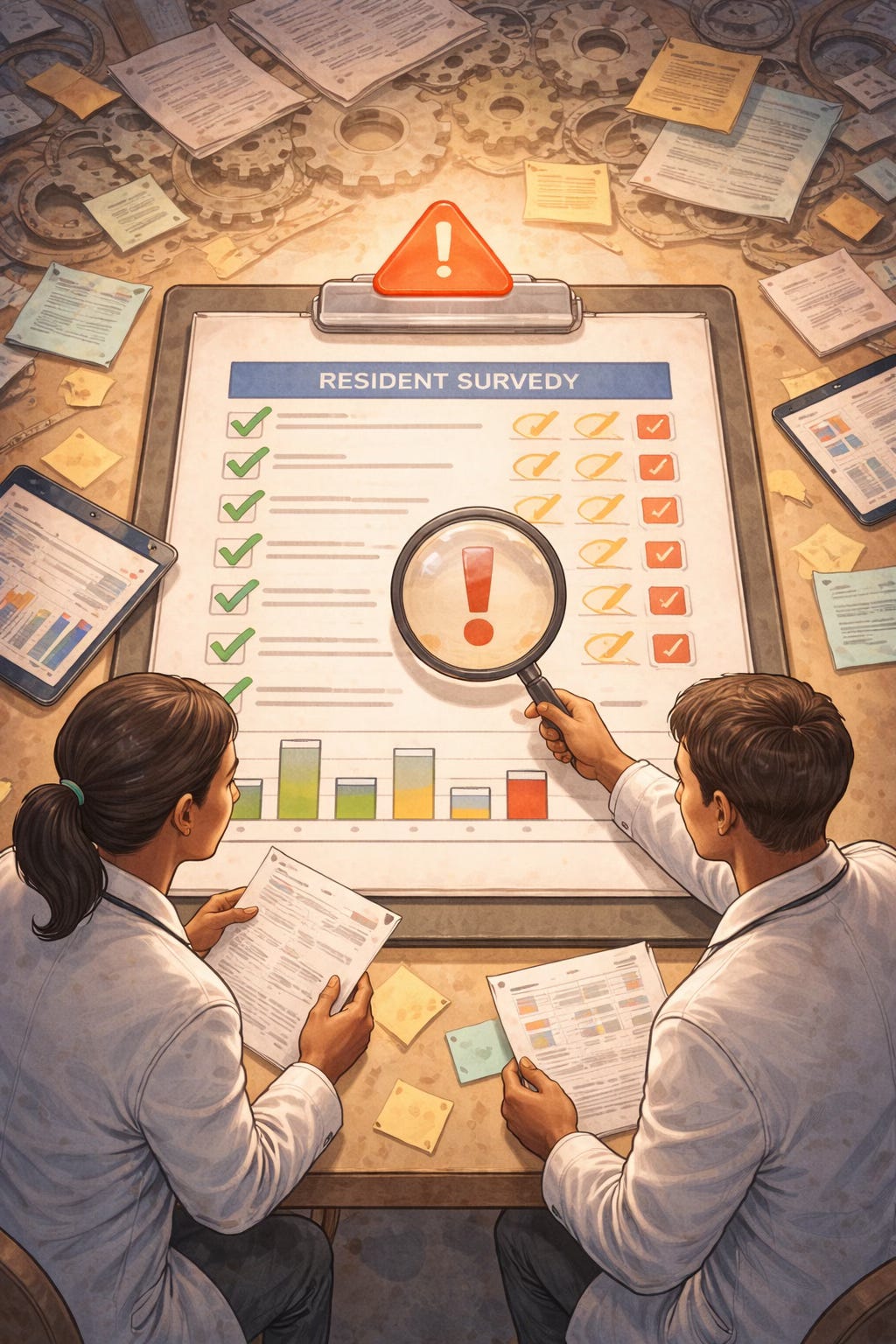
Every winter, it arrives
The ACGME Resident and Fellow Survey opens, inboxes fill, reminders go out, and a familiar tension settles across programs and institutions.
Some leaders brace for impact.
Some worry about optics.
Others quietly hope the number won’t change too much from last year.
But the truth is this: the survey itself is neither the program nor the solution.
It’s a signal.
And like all signals, its value depends on how well we understand what it is and what it isn’t.
What the Survey Is
At its core, the ACGME Resident and Fellow Survey is a snapshot of perception.
It captures how residents and fellows experience key elements of their training environment at a particular moment in time:
supervision
duty hours
patient safety and quality
educational content
professionalism
wellbeing
resources and support
Importantly it reflects, patterns, not individual stories.
It aggregates lived experiences into themes that can be compared:
across programs,
across specialities,
and against national benchmarks.
When reviewed thoughtfully, the survey can:
highlight areas of consistent strength,
surface misalignments between leadership intent and trainee experience,
and identify risks early- before they escalate into citations or site visits.
Used this way, the survey is a diagnostic tool, not a verdict.
What the Survey Is Not
The survey is not a full picture of the learning environment.
It cannot:
explain why residents answered the way they did,
capture nuance or context,
reflect recent changes that haven’t had time to settle,
or distinguish between systemic issues and isolated events.
It also can’t account for something leaders often underestimate:
how safe residents feel being honest.
In smaller programs, trainees may worry about being identifiable.
In larger ones, they may feel their voice won’t matter anyway.
Silence, neutrality, or “middle-of-the-road” answers down’t always mean things are fine. Sometimes they mean:
“I’m not sure this will change anything.”
“I don’t want to make trouble.”
“I’ve learned to adapt.”
The survey can tell us what residents are experiencing, but rarely how it feels to live inside it.
Where Leaders Get Stuck
The most common mistakes institutions make is treating survey results as:
a compliance exercise,
a defensive document,
or a scorecard to be explained away.
We see this when responses should like:
“That’s not what we meant.”
“Residents don’t see the full picture.”
“They didn’t understand the question.”
Maybe.
But, perception is the learning environment.
If residents consistently experience confusion, friction, or lack of support, the system is teaching something, whether or not it’s intentional.
What the Survey Can Reveal If We Let It
When paired with curiosity rather than fear, the survey can surface deeper truths:
Are policies clear in writing but confusing in practice?
Do residents know where to go for help or only where not to go?
Are wellness resources available, but culturally discouraged?
Do feedback mechanisms exist without visible follow-through?
Often, survey results don’t point to dramatic failures.
They point to small, chronic misalignments. The kind that quietly erode trust over time.
Turning Data Into Dialogue
The most effective institutions use the survey as a starting point, not an endpoint.
That means:
sharing results transparently with program leadership,
contextualizing trends rather than reacting to single items,
inviting residents into conversations about what the data reflects and what is misses,
and pairing survey findings with other inputs: exit interviews, focus groups, duty hour trends, evaluation data.
This approach sends a powerful message:
”We’re not just collecting your feedback. We’re listening for meaning".”
The Real Question the Survey Raises
Ultimately, the ACGME Resident and Fellow Survey asks institutions a deeper question than any single domain score:
Are we welling to look honestly at how our systems are experience, not just how they were designed?
Accreditation bodies can prompt reflection.
Surveys can highlight patterns.
But culture changes only when leaders choose to engage with what the data is trying to teach.
Not defensively.
Not peformatively.
But intentionally.
Closing Reflection
The ACGME Resident and Fellow Survey doesn’t define an institution.
But how an institution responds to it does.
Used well, the survey becomes a mirror. One that helps us see where the learning environment is aligned, where it’s strained, and where residents and fellows feel supported, heard, and safe enough to be honest.
And that kind of environment can’t be measured by a survey alone, but it often starts there.