
From Final Evaluation to Future Faculty: Reimagining the End of Residency

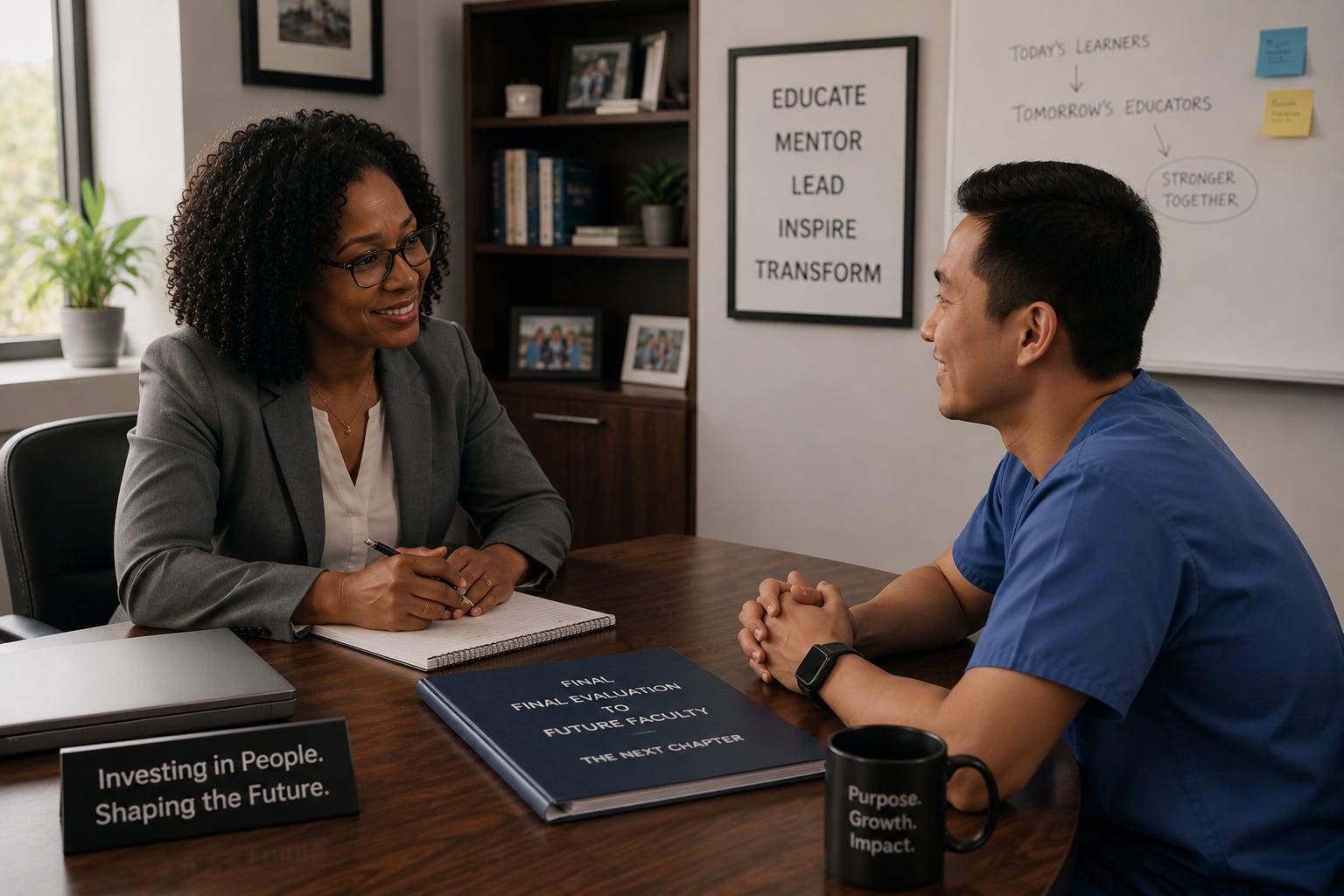
Every June, as graduation photos are taken and farewell speeches delivered, a quiet but consequential moment arrives in graduate medical education.
The final evaluation.
Most programs treat it as a closing document. Milestones reviewed. Competencies confirmed. Paperwork signed. A chapter closed.
But what if the final evaluation wasn’t the end of something? What if it was the beginning?
The Missed Moment
Many residents who cross the graduation stage aren’t just finishing training. They are stepping into new roles as attendings, as leaders, as future faculty. And yet we rarely treat that transition with the weight it deserves.
The final evaluation, the individual learning plan summary, the milestone data accumulated over years of training, these documents hold a picture of a physician that extends far beyond what the checkboxes capture. They hold patterns of strength, ares of potential, and the early architecture of a professional identity that is still being built.
For programs focused on faculty retention, leadership development, or academic career pathways, this moment holds untapped potential. Residents who are staying on or entering academic medicine deserve more than a checklist. They deserve a launchpad.
Reimagining the Final ILP
What if we used the final evaluation and milestone summary not just to close a chapter but to open the next one? What if these tools became a strategic blueprint one that reflects not only where the resident has been but where they are capable of going?
That kind of document would look different from what most programs currently produce. It would ask different questions and capture different things.
Has this resident shown initiative in quality improvement projects or team management? Have they demonstrated particular strength in bedside teaching, feedback delivery, or mentoring junior residents? What topics genuinely light them up academically, and how might those interests align with departmental needs? Where will they need deliberate mentorship as they navigate the shift from peer to supervisor?
None of these questions are about perfection. They are about possibility. They are about building a bridge from the identity the resident is leaving into the they are becoming.
Turning Evaluations Into Faculty Onboarding
Final evaluations and ILP summaries can become the first page of a faculty development portfolio. Not a ceremonial document that gets filed and forgotten, but a living record that informs how a new attending is welcomed, supported, and challenged in their next role.
Imagine what the looks like in practice.
You have excelled in procedural teaching throughout residency. Would you like to co-lead intern simulation next year? Your feedback style is thoughtful and specific- how can we support you in in becoming a formal coach for junior residents? The equity project you led in your third year had real institutional impact- have you considered presenting it regionally or writing it up for publication?
These are not just nice conversations. They are acts of institutional imagination. They say to a graduating resident: we see you not just as someone beginning in the next chapter of what you are capable of contributing.
That message, delivered at the right moment, changes how a new faculty member understands their relationship to the institution they are joining.
The Lifecycle Lens
Faculty development shouldn’t start at orientation. It should begin in residency.
When we use lifecycle thinking, when we prepare residents for their next professional identity rather than simply celebrating the one they are leaving we create continuity that most programs currently interrupt. The resident who graduates without that continuity has to rebuild momentum from scratch in a new role. The one who graduates with it carries forward the best of what their training revealed about them.
The questions worth asking at the program level are straightforward, even if the answers required real institutional investment. Are we tracking not just what residents accomplished, but what they are ready to do next? Are we inviting residents into a mindset of career design rather than compliance? What structures do we have in place to catch and cultivate the transition from the trainee to colleague?
A Tool for the Conversation
To support this kind of transition conversation, I’ve developed a brief reflection guide for programs directors and faculty to use in final ILP meetings. It is designed to take the conversation beyond milestone completion into the territory of professional identity, faculty readiness, and next-chapter development.
It covers for areas: leadership patterns observed during training, teaching and mentorship strengths, scholarly interests and potential, and growth edges to address in the first year of practice. The goal is not a comprehensive performance review but a forward-looking conversation that treats graduation a a beginning.
If you would like a copy, reply to this post or reach out directly and I will send it your way.
Closing Reflecton
Residency is not a terminal station. It is a threshold.
When we treat the final evaluation as a doorway to deeper development rather than a sign-off on completed training, we reshape something fundamental about the culture of academic medicine. We signal that the institution’s investment in a person does not end when the certificate is handed over. That the relationship between a training program and they physician it produces is not transactional but developmental and that development does not stop at graduation.
The residents crossing that thresholds this June deserves more than a closed file.
They deserve an institution that already knows what they are capable of next.